Stöbern
genialokal zum Startbildschirm hinzufügen
Installieren Sie die genialokal App auf Ihrem Startbildschirm für einen schnellen Zugriff und eine komfortable Nutzung.
Installieren Sie die genialokal App auf Ihrem Startbildschirm für einen schnellen Zugriff und eine komfortable Nutzung.
Tippen Sie einfach auf Teilen:
 Und dann auf "Zum Home-Bildschirm [+]".
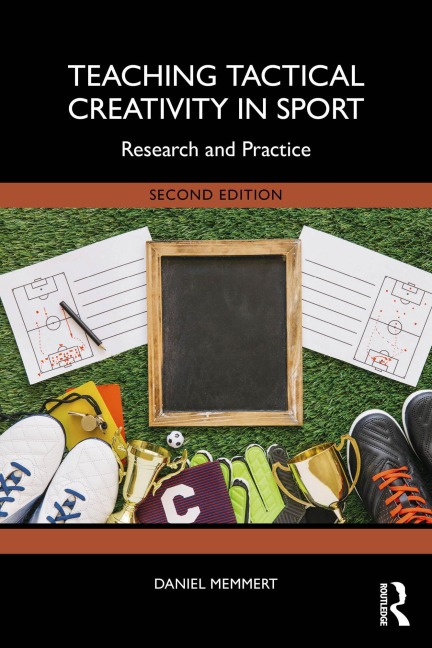
This new edition of Teaching Tactical Creativity in Sport bridges the gap between theory and practice in the development of tactical creativity in team and racket sports. Creativity is an essential component of sport performance. The player who can make fast or correct decisions that are both unexpected-and therefore less easily predicted by their opponent-and appropriate is the player who is likely to be successful. Drawing on interdisciplinary research from psychology, neuroscience, movement science, training science, education science, and computer science, it presents an updated Tactical Creativity Approach (TCA) as a groundbreaking framework for fostering divergent tactical thinking. Fully updated and revised for the classroom and featuring empirical studies, validated methods for creativity measurement, and ready-to-use teaching units, this new edition offers a unique resource for sports educators, coaches, and students. The book outlines essential rules for environmental and training conditions and suggests a wide range of game forms for teaching and coaching tactical creativity to children and young people. The second edition updates key research insights and expands practical applications across various sports and age groups, making it an essential guide for students of Sport Pedagogy, Sport Coaching, and Physical Education Methods as well as anyone dedicated to advancing creative problem-solving in sport.
Daniel Memmert is a Professor and the Executive Head of the Institute of Exercise Training and Sport Informatics at the German Sport University Cologne (GSUC). From 2009 to 2016, he was head at the Institute for Cognition and Sports Game Research at GSUC. In 2003, he earned a PhD (Award: DVS Young Scientist Award, Bronze) and habilitated in 2008 at the Elite University of Heidelberg (Award: DOSB Science Award, Bronze). In 2014, he was a Visiting Professor at the University of Vienna. His scientific work focuses on movement science (cognition and motor function), sports psychology (attention and motivation), and computer science in sports (big data, pattern recognition, and simulation). According to a publicly accessible database by Elsevier of the world's top 100,000 scientists, he ranks first in Germany in the field of Sport Science and eighth in the world in the field of Sports Science/Experimental Psychology. He has an H-index of 75 (i10-index 275) and has raised more than ten million euros in third-party funding, including nine DFG projects in the field of computer science and five DFG projects in the field of psychology. In addition, he has published more than 350 articles in international journals, 55 books, and 50 book chapters. Since 2023, he has been Editor-in-Chief of the Journal of Applied Sport and Exercise Psychology, and since 2025 he has been Executive Editor for the International Journal of Sport and Exercise Psychology. He holds coaching licenses in the sports of soccer, tennis, snowboarding, as well as alpine skiing. His institute cooperates/cooperated with various soccer teams worldwide, the German national soccer team, and DAX companies and organized the first international master's degree course in Match Analysis.
1. Creativity-An Introduction. 2. Creativity in Science. 3. Creativity in Physical Education and Team and Racket Sports. 4. Learning and Teaching within the Scope of the Tactical Creativity Approach in Team and Racket Sports. 5. Empirical Evidence of the Tactical Creativity Approach in Team and Racket Sports. 6. How to Measure Tactical Creativity in Team and Racket Sports? 7. Practical Implications of the Tactical Creativity Approach. 8. Summary.