
Stöbern
genialokal zum Startbildschirm hinzufügen
Installieren Sie die genialokal App auf Ihrem Startbildschirm für einen schnellen Zugriff und eine komfortable Nutzung.
Installieren Sie die genialokal App auf Ihrem Startbildschirm für einen schnellen Zugriff und eine komfortable Nutzung.
Tippen Sie einfach auf Teilen:
 Und dann auf "Zum Home-Bildschirm [+]".
Ihr gewünschter Artikel ist in 0 Buchhandlungen vorrätig - wählen Sie hier eine Buchhandlung in Ihrer Nähe aus:

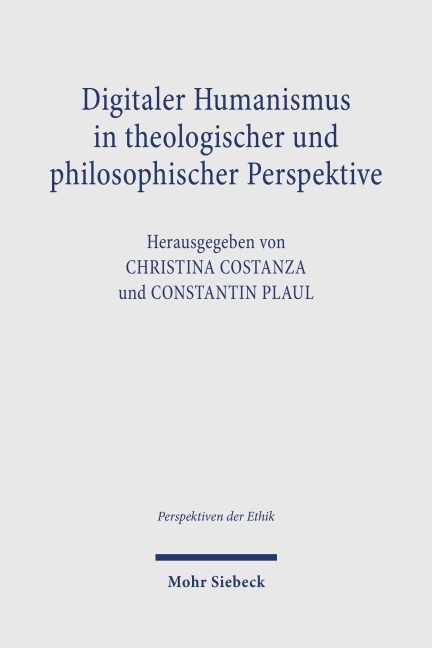
Starting from ethical needs for orientation in the digital age, the philosophical programme of digital humanism is examined and further developed from the perspective of theological ethics. The point of departure is a diagnostic analysis of the present age and an ethical examination of the challenges posed by digitality in contemporary society. In a subsequent step, normative perspectives from Protestant theology and digital humanism are presented. In this context, points of contact and areas of overlap between the two perspectives become apparent, giving rise to conceptual-historical and theoretical analyses of the relationship between theology and humanism. These analyses, in turn, prepare the groundwork for a programme of dialogue between digital humanism and theological media ethics. This programme is subsequently specified in a systematic manner through the key concepts of freedom, reason, human dignity, responsibility, the common good, and education.
In the concluding section, the editors of the volume reflect on the question, already posed in the introduction, of how the relationship between Protestant digital ethics and the project of digital humanism should be appropriately understood. In doing so, they substantiate the thesis that the relationship between the two projects is a productive one. Furthermore, they argue that digital humanism should not be regarded as a secular alternative to a theological-ethical perspective; rather, it should be understood as an overarching concept for an ethical project that integrates both secular and theological programmes.
Christina Costanza (Herausgegeben von)
Born 1977; 2008 Doctorate and 2024 Habilitation in Systematic Theology at the University of Göttingen; Professor of Dogmatics with a focus on Gender Studies at the Humboldt University of Berlin.
Constantin Plaul (Herausgegeben von)
Born 1981; 2017 Doctorate and 2023 Habilitation in Systematic Theology at Martin Luther University Halle-Wittenberg; Professor of Systematic Theology and Contemporary Theological Issues at the Institute of Protestant Theology, University of Regensburg.
Christina Costanza und Constantin Plaul: Einleitung Teil I: Menschsein in digitalen Kulturen. Zeitdiagnostische Aufarbeitung praktischer und ethischer Herausforderungen Nick Couldry: Data Colonialism and the Capture of Knowledge through AI - Gerhard Schreiber: Text aus der Retorte. KI-Textgeneratoren aus technikethischer Perspektive - Christian Schicha: Kommunikationskulturen. Positionen zu Sensibilität und Diskurstapferkeit im Überblick Teil II: Digitaler Humanismus und theologische Medienethik. Zur Programmatik einer Verständigung Florian Höhne: Die Bedeutung des Menschen in der theologischen Medienethik - Constantin Plaul: Das philosophische Programm des Digitalen Humanismus - Christina Costanza und Constantin Plaul: Gespräch mit Julian Nida-Rümelin und Nathalie Weidenfeld zum Digitalen Humanismus in philosophischer und theologischer Perspektive Teil III: Begriffsgeschichtliche und konzeptionelle Beobachtungen zum Verhältnis von Theologie und Humanismus Marta Quatrale: Zwischen Gnade und Erkenntnis: Humanismus und Reformation im Spannungsfeld der Ideengeschichte - Friedemann Stengel: Was ist Humanismus? Historische und kritische Perspektiven - Isabella Schlehaider: Queer(ing) Ethics. Einsätze einer posthumanistischen Poethik der Beziehungen Teil IV: Digitaler Humanismus in theologischer und philosophischer Perspektive: Systematische Konkretionen anhand ausgewählter Schlüsselbegriffe Robert Martin Jockel: Dimensionen der Freiheit. Zur Pragmatik eines mehrdeutigen Begriffs in digitalitätsethischen Diskursen evangelischer Theologie - Mario Berkefeld: Anthropologische Unschärfen. Kant, Cassirer und die Herausforderung Künstlicher Personalität - Kathrin Bruder: Vom Recht vom Menschen behandelt zu werden - Lukas Johrendt: Verantwortungssubjekte und -objekte in datifizierten Gesellschaften. Diskursbeobachtungen - Paula Koch und Antje Maaser: Das Gemeinwohl vor den Herausforderungen der digitalen Transformation - Georg Bucher: Dem Ruf der Sirenen widerstehen lernen. Religionspädagogische Anmerkungen zum Projekt des Digitalen Humanismus Christina Costanza und Constantin Plaul: Schluss
