Und dann auf "Zum Home-Bildschirm [+]".

Stöbern
genialokal zum Startbildschirm hinzufügen
Installieren Sie die genialokal App auf Ihrem Startbildschirm für einen schnellen Zugriff und eine komfortable Nutzung.
Installieren Sie die genialokal App auf Ihrem Startbildschirm für einen schnellen Zugriff und eine komfortable Nutzung.
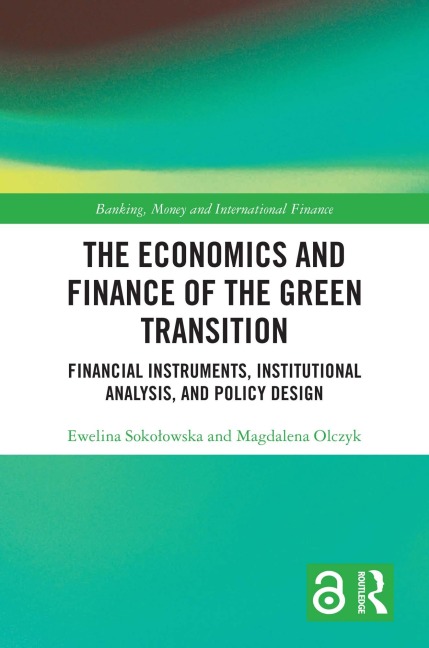
The green transition is no longer simply a question of better technologies or stronger carbon prices. It is a question of whether decarbonisation can remain feasible, investable, and socially durable under volatility, geopolitical rivalry, ecological limits, and distributional conflict. This book examines the transition as a systemic process shaped by bottlenecks, institutional capacity, and the interaction of policy, finance, and social legitimacy. Bringing together political economy, governance, and green finance, this book analyses how policy instruments, metrics, resilience, and risk architectures condition the pace and durability of transformation. It explores the design of policy mixes, the role of indicators as governance devices, and the architecture of de-risking, market-making, coordination, disclosure, and supervisory frameworks. The discussion also addresses digital innovation, greenwashing risks, and the ways in which climate and regulatory uncertainty reshape capital allocation. Comparative evidence from the European Union, the United States, and China, together with analysis of European electricity markets, shows how transition strategies succeed or fail as constraints shift. Written for academics, policymakers, regulators, practitioners, and graduate students in economics, finance, and sustainability, this book offers a framework for understanding how the transition can be governed under turbulence. It provides tools for identifying binding constraints, evaluating resilience, and understanding how credibility, sequencing, and uncertainty affect investment. Rather than offering a blueprint, it shows how transitions depend on managing sequences of constraints over time. Its central message is that a sustainable transition depends not on ambition alone, but on institutions capable of making long-term commitment credible under structural uncertainty.
Ewelina Sokolowska is Professor of Economics and Head of the Department of Economy, Faculty of Management and Economics, Gdansk University of Technology, Poland. Magdalena Olczyk is a professor in the Department of Economics, Faculty of Management and Economics, Gdansk University of Technology, Poland.
Introduction 1. The Green Economy: Paradigms and Design Trade-offs 2. Economic Instruments in the Energy Transition 3. Metrics, Evaluation, and Resilience 4. The SRAF Dashboard: Comparative Resilience Profiles (EU27, United States, China, 2015-2024) 5. Green Finance as Institutional Architecture 6. The Ontology of Transformational Risk 7. Financial Decision under Regime-Dependent Risk 8. Regime Dynamics and Tail Risk 9. Conclusions Index