Und dann auf "Zum Home-Bildschirm [+]".

Stöbern
genialokal zum Startbildschirm hinzufügen
Installieren Sie die genialokal App auf Ihrem Startbildschirm für einen schnellen Zugriff und eine komfortable Nutzung.
Installieren Sie die genialokal App auf Ihrem Startbildschirm für einen schnellen Zugriff und eine komfortable Nutzung.
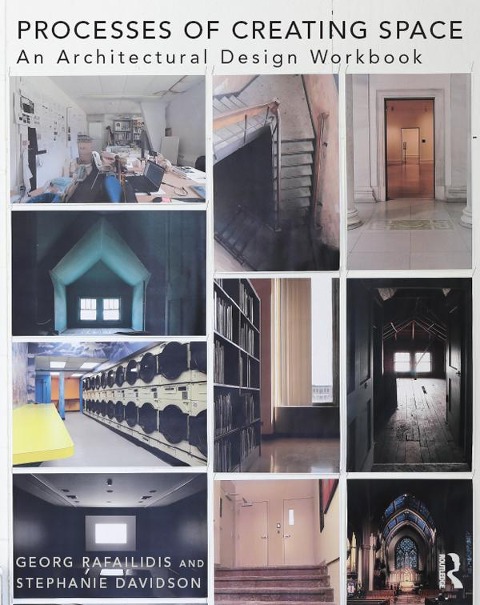
Processes of Creating Space is a workbook for beginning designers that shows how to generate space with user experiences in mind. It explains how to keenly perceive your world and seamlessly integrate architectural representation into your design process. The book uses two main strategies, blending the design process with material processes and media techniques and 'experiential typologies' - emphasising first-hand experience of space. Five highly experimental assignments explore the interwoven relationship between design process and design tools, to help you learn when to incorporate writing, architectural photography, macro photography, orthographic projection, perspective projection, hand-drawing, CAD, mass modelling, hot wire foam cutting, 3D modelling, multi-part plaster mold making, slip casting, plaster casting, paper casting, monocoque shell structures, working with latex, concrete, twine pulp, full-scale prototyping and more. Illustrated with more than 350 color images, the book also includes a section on material fabrication techniques and a glossary of technical terms. An eResource containing downloadable essays, stop-motion videos, sample schedules, and supplementary information can be found here: www.routledge.com/9781138903685
Georg Rafailidis and Stephanie Davidson are faculty at the School of Architecture and Planning, State University of New York at Buffalo, USA. They taught previously at the RWTH Aachen University, Germany. Both practice architecture as Davidson Rafailidis.
Acknowledgments. Introduction. 1. Introduction 1.1 Generating/Forming/Rethinking Space 2. Methodology 2.1 Perception 2.2 Control and Chance 2.3 Material Processes 3. Manual of Spatial Processes 3.1 Experiential Assessment of Space 3.2 Survey of Space 3.3 Solid-void Inversion of Space 3.4 Inhabitation and Space 3.5 Structure and Space 4. Manual of Techniques 4.1 Taking Photos of Spaces 4.2 Hot Wire Foam Cutting 4.3 Orthographic Projection and Multi-View Drawings 4.4 Multi-Part Rigid Mold Making 4.5 Slip Casting 4.6 Perspectival Projection - One-Point Perspective Drawing 4.7 Paper Casting to make a Monocoque 4.8 Taking Photos of Scale Models 4.9 Working with Concrete 4.10 Working with Latex 4.11 Planar Structures Glossary of Technical Terms and Materials. Bibliography. Index
Dieses eBook wird im PDF-Format geliefert und ist mit einem Adobe Kopierschutz (DRM) versehen. Sie können dieses eBook mit allen Geräten lesen, die das PDF-Format und den Adobe Kopierschutz (DRM) unterstützen.
Zum Beispiel mit den folgenden Geräten:
• tolino Reader
Laden Sie das eBook direkt über den Reader-Shop auf dem tolino herunter oder übertragen Sie das eBook auf Ihren tolino mit einer kostenlosen Software wie beispielsweise Adobe Digital Editions.
• Sony Reader & andere eBook Reader
Laden Sie das eBook direkt über den Reader-Shop herunter oder übertragen Sie das eBook mit der kostenlosen Software Sony READER FOR PC/Mac oder Adobe Digital Editions auf ein Standard-Lesegeräte mit epub- und Adobe DRM-Unterstützung.
• Tablets & Smartphones
Möchten Sie dieses eBook auf Ihrem Smartphone oder Tablet lesen, finden Sie hier unsere kostenlose Lese-App für iPhone/iPad und Android Smartphone/Tablets.
• PC & Mac
Lesen Sie das eBook direkt nach dem Herunterladen mit einer kostenlosen Lesesoftware, beispielsweise Adobe Digital Editions, Sony READER FOR PC/Mac oder direkt über Ihre eBook-Bibliothek in Ihrem Konto unter „Meine eBooks“ - „online lesen“.
Schalten Sie das eBook mit Ihrer persönlichen Adobe ID auf bis zu sechs Geräten gleichzeitig frei.
Bitte beachten Sie, dass die Kindle-Geräte das Format nicht unterstützen und dieses eBook somit nicht auf Kindle-Geräten lesbar ist.