Und dann auf "Zum Home-Bildschirm [+]".

Stöbern
genialokal zum Startbildschirm hinzufügen
Installieren Sie die genialokal App auf Ihrem Startbildschirm für einen schnellen Zugriff und eine komfortable Nutzung.
Installieren Sie die genialokal App auf Ihrem Startbildschirm für einen schnellen Zugriff und eine komfortable Nutzung.
Ihr gewünschter Artikel ist in 0 Buchhandlungen vorrätig - wählen Sie hier eine Buchhandlung in Ihrer Nähe aus:

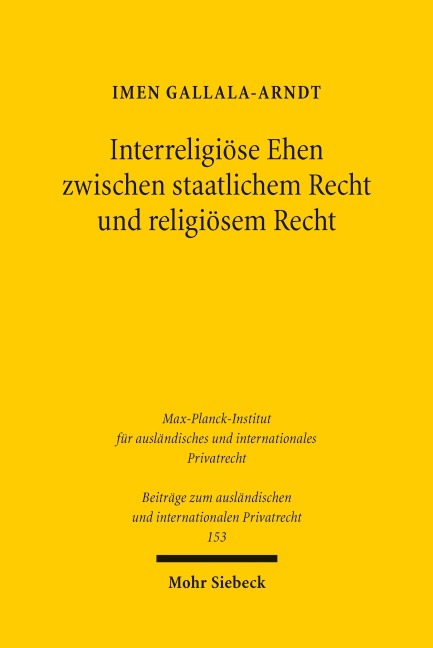
The relationship between state law and religious law is one of the central points of tension in modern legal systems within religiously pluralistic societies. In this study, the author gives a comparative analysis of the treatment of interreligious marriages in Israel, Lebanon, and Tunisia and investigates the reception of a religion-based ban on marriage by German courts. Central focal points are models of legal pluralism, the manner in which state systems adopt religious norms, and state oversight of religious authority. Whereas Israel and Lebanon give religious courts broad competence, Tunisia has put the question of personal status largely in the hands of state authorities. The study makes a valuable contribution to the debate on the integration of religious normativity in secular contexts in the international and German legal arena.
Born 1975; studied law in Tunis and Heidelberg; 2007 PhD (University of Heidelberg); research associate at various Max Planck Institutes: for Comparative Public Law and International Law in Heidelberg, for Comparative and International Private Law in Hamburg, and for Social Anthropology in Halle; 2023 habilitation (University of Erlangen-Nuremberg); associated researcher at the Max Planck Institute for Social Anthropology in Halle and lecturer in Islamic law at the University of Hamburg.