Und dann auf "Zum Home-Bildschirm [+]".

Stöbern
genialokal zum Startbildschirm hinzufügen
Installieren Sie die genialokal App auf Ihrem Startbildschirm für einen schnellen Zugriff und eine komfortable Nutzung.
Installieren Sie die genialokal App auf Ihrem Startbildschirm für einen schnellen Zugriff und eine komfortable Nutzung.
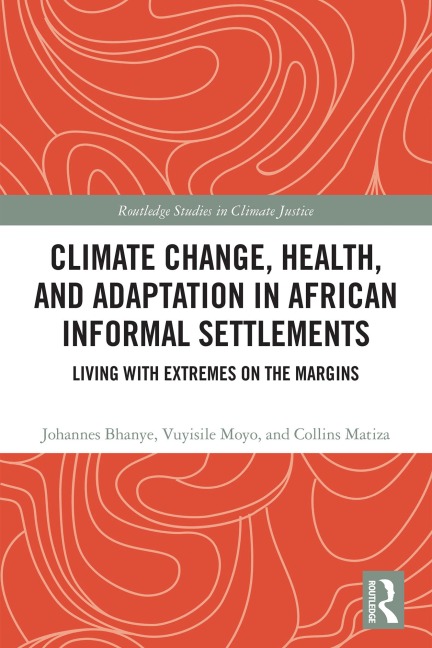
This transdisciplinary book explores how climate extremes-specifically extreme heat and urban flooding-are experienced, governed, and resisted within African informal settlements. Focusing on the nexus of environmental stress, public health inequities, infrastructural fragility, and adaptation politics, the authors unpack how these converging crises disproportionately affect marginalised urban populations and expose the limitations of dominant climate governance models. The book takes Cape Town as its principal empirical site, particularly the informal settlements of Khayelitsha, Philippi, and Masiphumelele. These settlements serve as "urban laboratories" through which the book investigates the everyday, embodied, and gendered impacts of climate change. While deeply grounded in the Cape Town context, the book also draws comparative insights from similarly climate-vulnerable and socially complex informal settlements in Lagos (Makoko), Nairobi (Kibera and Mukuru), Accra (Agbogbloshie), and Dhaka (Korail), situating African experiences within a broader Global South urban adaptation discourse. The book is structured around eight thematic chapters, each advancing a layered understanding of climate risk and resilience through different empirical, theoretical, and methodological lenses. Through this multi-layered exploration, Climate Change, Health, and Adaptation in African Informal Settlements positions informal settlements not as passive recipients of adaptation, but as generative sites of innovation, knowledge, and political agency. It offers a compelling and much-needed intervention into both academic and policy debates, arguing that reimagining climate adaptation from the margins is not only possible-it is essential. This book will be of great interest to students and scholars of urban development, climate justice, health equity, and environmental governance.
Johannes Bhanye is an Urban Planner and a Postdoctoral Research Fellow at the African Climate and Development Initiative (ACDI), University of Cape Town, where his work focuses on climate-induced disasters, hydro-citizenship, urban flood adaptation, and adaptive governance in informal settlements. Vuyisile Moyo is a Postdoctoral Research Fellow at African Climate and Development Initiative (ACDI), University of Cape Town, working on Heat Adaptation in Cape Town informal settlements. Collins Matiza is a Postdoctoral Research Fellow at the Climate Risk Lab under the African Climate and Development Initiative (ACDI), University of Cape Town, where his work equips communities and decision-makers with the spatial intelligence needed to adapt to a changing climate.
1 Framing Climate Extremes and Urban Informality: Challenges, Vulnerabilities, and Pathways to Adaptation 2 Navigating the Impacts of Extreme Heat in Cape Town's Informal Settlements 3 Climate Change and Extreme Heat Policies in South Africa: A Governance Critique 4 Hydro-Citizenship and Flooding on the Margins: Lived Experiences and Everyday Adaptation in Cape Town's Rough Neighbourhoods 5 Embodied Floods: Health, Gender, and Adaptation in the Face of Urban Flooding in Cape Town's Rough Neighbourhoods 6 Spatiotemporal Analysis of Informal Settlement Dynamics Using Deep Learning and Sentinel-2 Time Series: A Cape Town Case Study 7 Uncertainty-Informed Bayesian Flood Hazard Mapping for Cost-Effective Municipal Planning: A Spatial Decision-Support Framework for eThekwini 8 Towards Just and Inclusive Climate Adaptation: Policy Pathways and Future Directions for African Informal Settlements