Und dann auf "Zum Home-Bildschirm [+]".

Stöbern
genialokal zum Startbildschirm hinzufügen
Installieren Sie die genialokal App auf Ihrem Startbildschirm für einen schnellen Zugriff und eine komfortable Nutzung.
Installieren Sie die genialokal App auf Ihrem Startbildschirm für einen schnellen Zugriff und eine komfortable Nutzung.
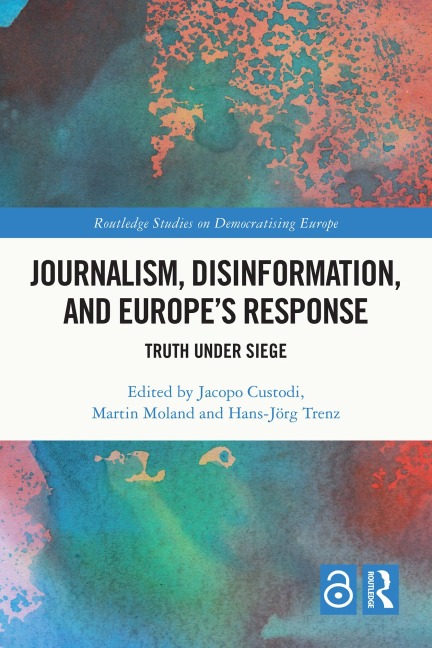
This edited book examines the relationship between journalism, democracy, and disinformation in contemporary Europe. Drawing on original empirical research with journalists and media regulators, it provides a timely analysis of the European Union's evolving regulatory response to disinformation and media pluralism, while foregrounding the perspectives of those directly involved in interpreting and implementing these changes. Through a comparative study of seven countries - Spain, Italy, Norway, Iceland, Croatia, Poland, and Bulgaria - the book explores how media actors across diverse political, institutional, and regulatory contexts understand and respond to post-truth politics. In doing so, it investigates whether a shared European normative space around journalism, media freedom, and democracy is beginning to take shape. This book will be of interest to students, scholars, and practitioners in European studies, media studies, journalism, political communication, and cultural sociology.
Jacopo Custodi is a Postdoctoral Research Fellow in Political Science at the Scuola Normale Superiore, Italy. Martin Moland is a Postdoctoral Research Fellow at the Hertie School, Germany, and an affiliate of the ARENA, Centre for European Studies, University of Oslo, Norway. Hans-Jörg Trenz is Professor of Sociology of Culture and Communication at the Scuola Normale Superiore, Italy.
Introduction: Journalism, disinformation, and Europe's response 1. The EU regulatory approach to media pluralism and disinformation in a global context: exceptional or trendsetting? 2. The impact of EU regulation on media in Spain: Debates about fighting disinformation 3. Italian journalism amid declining standards and counter-disinformation efforts 4. The state of journalism in Norway and Iceland in a time of fake news and disinformation: Highly trusted yet still threatened 5. Journalism in Croatia in the era of post-truth 6. Disinformation and the media in Poland: Between polarisation and European regulation 7. Bulgarian journalism amid fragile pluralism and declining professional standards Conclusion: Stakeholder perceptions, Europeanised norms and where we should go from here