Und dann auf "Zum Home-Bildschirm [+]".

Stöbern
genialokal zum Startbildschirm hinzufügen
Installieren Sie die genialokal App auf Ihrem Startbildschirm für einen schnellen Zugriff und eine komfortable Nutzung.
Installieren Sie die genialokal App auf Ihrem Startbildschirm für einen schnellen Zugriff und eine komfortable Nutzung.
Ihr gewünschter Artikel ist in 0 Buchhandlungen vorrätig - wählen Sie hier eine Buchhandlung in Ihrer Nähe aus:

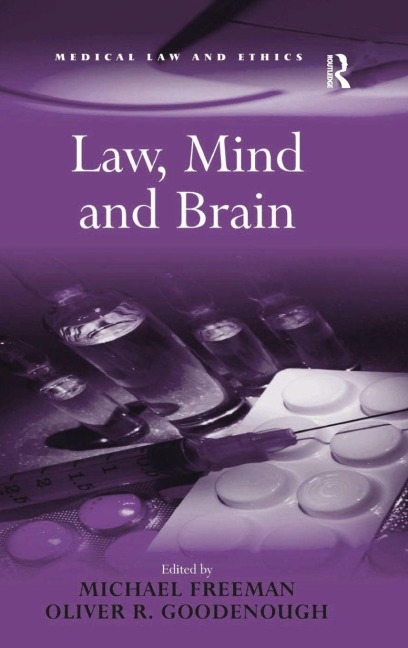
This edited collection brings together contributions from experts in criminal behaviour, civil law and jurisprudence. Suggesting that legal scholarship and practice will be increasingly enriched by an interdisciplinary study of law, mind and brain, this collection is a valuable addition to the emerging field of neurolaw.
Michael Freeman is Professor of English Law at University College London. His research interests are in cultural pluralism in particular in relation to the rights of children and in medical ethics particularly in relation to medically assisted reproduction.He has published in the areas of Family Law, Child Law and Policy, Children's Rights, Medicine, Ethics and the Law and Medical Law, Jurisprudence and Legal Theory. He is the author of over 40 books, editor of a large number of international journals and a Fellow of the British Academy.
Contents: Preface; Introduction, Michael Freeman and Oliver R. Goodenough; Law, responsibility and the brain, Dean Mobbs, Hakwan C. Lau, Owen D. Jones and Christopher D. Frith; Brain imaging and courtroom evidence: on the admissibility and persuasiveness of fMRI, Neal Feigenson; Mind the gap: problems of mind, body and brain in the criminal law, Lisa Claydon; Self-exclusion agreements: should we be free not to be free to ruin ourselves? Gambling, self-exclusion agreements and the brain, Florian Wagner-Von Papp; The problems with blaming, Theodore Y. Blumoff; Why distinguish 'mental' and 'physical' illness in law of involuntary treatment?, John Dawson and George Szmukler; A stable paradigm: revisiting capacity, vulnerability and the rights and claims of adolescents after Roper v. Simmons, Catherine J. Ross; Thinking like a child: legal implications of recent developments in brain research for juvenile offenders, Katharine Hunt Federle and Paul Skendelas; Legal implications of memory-dampening, Adam Kolber; Reframing the good death: enhancing choice in dying, neuroscience, end-of-life research and the potential of psychedelics in palliative care, Robin Mackenzie; Equality in exchange revisited from an evolutionary (genetic and cultural) point of view, Bart Du Laing; Just (and efficient?) compensation for government expropriations, Jeffrey Evans Stake; Examining the biological bases of family law: lessons to be learned from the evolutionary analysis of law, June Carbone and Naomi Cahn; Why do good people steal intellectual property?, Oliver R.Goodenough and Gregory Decker; Cues in the courtroom: when do they improve jurors' decisions?, Cheryl Boudreau; Reflections on reading: words and pictures and law, Christina Spiesel; Index.