Stöbern
genialokal zum Startbildschirm hinzufügen
Installieren Sie die genialokal App auf Ihrem Startbildschirm für einen schnellen Zugriff und eine komfortable Nutzung.
Installieren Sie die genialokal App auf Ihrem Startbildschirm für einen schnellen Zugriff und eine komfortable Nutzung.
Tippen Sie einfach auf Teilen:
 Und dann auf "Zum Home-Bildschirm [+]".
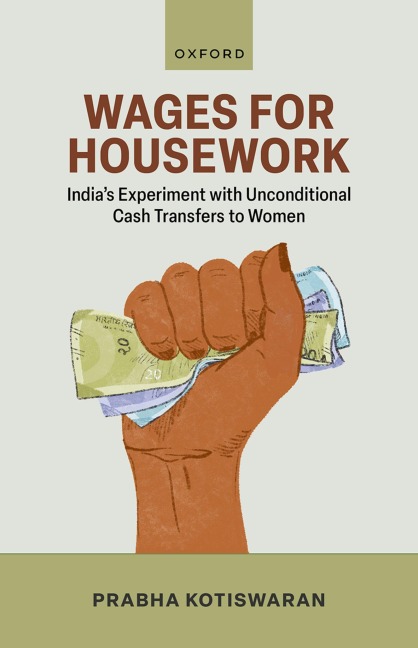
A silent revolution is underway in India today. Starting in 2020, twelve states have rolled out unconditional cash transfers to nearly 118 million women. While the media disparages these transfers as 'freebies', Wages for Housework: India's Experiment with Unconditional Cash Transfers to Women offers the first book-length study of these transfers, using social reproduction feminism, particularly the wages for housework campaign, to theorize unconditional cash transfers as providing economic recognition of women's unpaid domestic and care work. Against the backdrop of a low female labour force participation rate, a residual welfare regime, and an entrenched culture of gendered familialism wherein women are presumed responsible for care, the book addresses arguments for and against unconditional cash transfers in feminist economics and welfare theory. In doing so, it recollects the vision of the founding mothers of the Indian Constitution who advocated for the recognition of women's unpaid work. It traces how Indian courts have, since Independence, treated women's unpaid domestic and care work as being on par with an occupation to hold that the economic recognition of unpaid work is a step towards the constitutional vision of equality and dignity. Through an in-depth study of unconditional cash transfers in three states, namely, Goa, Assam, and West Bengal (implemented in 2013, 2020, and 2021, respectively), Kotiswaran elaborates on state-specific welfare regimes and analyses the implementation of cash transfers through interviews with bureaucrats, academics, feminist activists, and women beneficiaries to understand if and how they have resulted in women's empowerment, whether in terms of education, paid employment, or the gendered division of labour. In conclusion, the work posits that unconditional cash transfers represent an unprecedented and welcome expansion of the Indian welfare regime and to be truly gender transformative, they need to be embedded in a broader feminist agenda for care. This is an open access title available under the terms of a CC BY-NC-ND 4.0 licence. It is free to read on Oxford Scholarship Online (OSO) and offered as a free PDF download from OUP and selected open access locations.
Prabha Kotiswaran is Professor of Law and Social Justice at King's College London. Her main research areas include criminal law, transnational criminal law, feminist legal studies, and the sociology of law. She has authored and edited numerous books and journal articles. Select books include Dangerous Sex, Invisible Labour: Sex Work and the Law in India (Princeton, 2011) and Governance Feminism: An Introduction (University of Minnesota Press, 2018). Her research has received funding from the Arts and Humanities Research Council, Economic and Social Research Council, Leverhulme Trust, Journal of Law and Society, and Institute for Global Law & Policy, Harvard Law School. She was awarded the Philip Leverhulme Prize for Law in 2014. She was most recently Principal Investigator for an EU-funded consolidated grant, the Laws of Social Reproduction project.
- .: Recognising India's Silent Majority: An Introduction - Part I. - Chapter 1: Feminists Debate Wages for Housework - Chapter 2: Towards a Feminist Theory of the Postcolonial Welfare State - Chapter 3: Wages for Housework Jurisprudence: Prospects for Constitutionalising Social Reproduction - Part II. - Chapter 4: Goa's Griha Aadhar Scheme: A Missed Opportunity - Chapter 5: Between Family and State: Orunodoi and Prospects for Women's Empowerment in Assam - Chapter 6: Finally a feminist welfare state? The Lakshmir Bhandar Scheme in West Bengal - Part III. - Chapter 7: India Needs a Care Manifesto
Dieses eBook wird im PDF-Format geliefert und ist mit einem Adobe Kopierschutz (DRM) versehen. Sie können dieses eBook mit allen Geräten lesen, die das PDF-Format und den Adobe Kopierschutz (DRM) unterstützen.
Zum Beispiel mit den folgenden Geräten:
• tolino Reader
Laden Sie das eBook direkt über den Reader-Shop auf dem tolino herunter oder übertragen Sie das eBook auf Ihren tolino mit einer kostenlosen Software wie beispielsweise Adobe Digital Editions.
• Sony Reader & andere eBook Reader
Laden Sie das eBook direkt über den Reader-Shop herunter oder übertragen Sie das eBook mit der kostenlosen Software Sony READER FOR PC/Mac oder Adobe Digital Editions auf ein Standard-Lesegeräte mit epub- und Adobe DRM-Unterstützung.
• Tablets & Smartphones
Möchten Sie dieses eBook auf Ihrem Smartphone oder Tablet lesen, finden Sie hier unsere kostenlose Lese-App für iPhone/iPad und Android Smartphone/Tablets.
• PC & Mac
Lesen Sie das eBook direkt nach dem Herunterladen mit einer kostenlosen Lesesoftware, beispielsweise Adobe Digital Editions, Sony READER FOR PC/Mac oder direkt über Ihre eBook-Bibliothek in Ihrem Konto unter „Meine eBooks“ - „online lesen“.
Schalten Sie das eBook mit Ihrer persönlichen Adobe ID auf bis zu sechs Geräten gleichzeitig frei.
Bitte beachten Sie, dass die Kindle-Geräte das Format nicht unterstützen und dieses eBook somit nicht auf Kindle-Geräten lesbar ist.