Und dann auf "Zum Home-Bildschirm [+]".

Stöbern
genialokal zum Startbildschirm hinzufügen
Installieren Sie die genialokal App auf Ihrem Startbildschirm für einen schnellen Zugriff und eine komfortable Nutzung.
Installieren Sie die genialokal App auf Ihrem Startbildschirm für einen schnellen Zugriff und eine komfortable Nutzung.
Ihr gewünschter Artikel ist in 0 Buchhandlungen vorrätig - wählen Sie hier eine Buchhandlung in Ihrer Nähe aus:

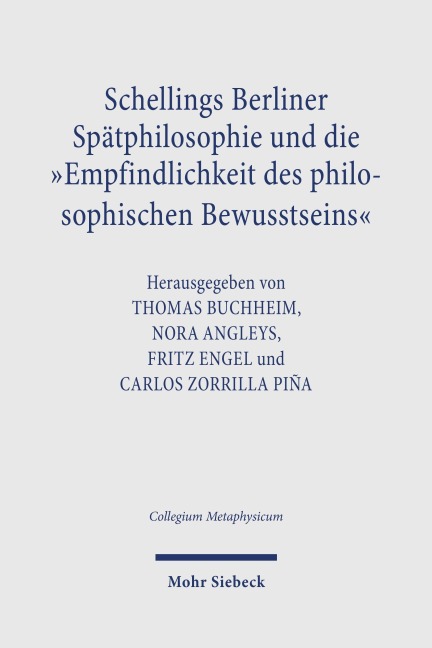
The contributions collected in this volume address a phase in Schelling's philosophical thought that has so far received little scholarly attention, despite its considerable philosophical significance: his final and thoroughly revised late philosophy from 1846 onward - that is, well after the Berlin lectures on the Philosophy of Revelation (1841-44). Based solely on the latter, contemporary critics had already concluded that Schelling's late philosophy constituted a relapse into a philosophical system that fell short of the critical standards for permissible metaphysics established by Kant.
In contrast, this volume turns its attention squarely to Schelling's final working period and retraces the clearly structured revision that is his final philosophy, a revision aimed at a metaphysics that is genuinely critically-compliant, but also finds the methodological justification to advance beyond Kant. The defining text of and for this last phase of Schelling's work is the Presentation of the Purely Rational Philosophy , which accordingly stands at the center of this volume.
The contributions to this volume retrace certain strands of this philosophical revision across three central themes: (1) the relief of reason from its epistemological responsibility pertaining to God, (2) the treatment of metaphysical questions grounded in a historical human consciousness, and (3) the philosophical-scientific treatment of religion as an independent line of development of human consciousness. In addition, (4) the volume presents a previously unpublished letter - the 'Vermächtnisbrief' - in which Schelling conveys to his son (and editor) the decisive philosophical commitments of his final philosophy. The 'Vermächtnisbrief' is published for the first time and explored in its philosophical potential.
Thomas Buchheim (Herausgegeben von)
Geboren 1957; 1984 Promotion und 1991 Habilitation an der Universität München; 1994 Ernennung zum Professor in Mainz; Ordinarius für Philosophie, speziell Metaphysik und Ontologie, in München.
Nora Angleys (Herausgegeben von)
Geboren 1986; wissenschaftliche Mitarbeiterin und Promovendin im DFG-Projekt "Schellings unvollendetes System".
Fritz Engel (Herausgegeben von)
Geboren 1996; wissenschaftlicher Mitarbeiter und Promovend im DFG-Projekt "Schellings unvollendetes System".
Carlos Zorrilla Piña (Herausgegeben von)
Geboren 1987; 2021 Promotion an Emory University; 2020-25 wissenschaftlicher Mitarbeiter im DFG-Projekt "Schellings unvollendetes System"; Assistenz-Professor für die Geschichte der Philosophie an der Katholischen Privat-Universität Linz.
I. KRITIK UND KRISIS: SELBSTKRITISCHE PHILOSOPHIE ALS SYSTEMATISCHE METAPHYSIK
Thomas Buchheim: Schellings Systemverständnis in seiner spätesten Philosophie - Markus Gabriel: Der Kontrast von negativer und positiver Philosophie - Henning Tegtmeyer: Zum Status der Metaphysik in Schellings Spätphilosophie - Marcela García-Romero: Crisis as Method in Schelling's Darstellung der reinrationalen Philosophie - Alexandra Roux: Science, Nescience and Dialectics in Schelling's later philosophy - Carlos Zorrilla-Piña: The Latest Schelling and the Expansion of Philosophical Theory
II. PHILOSOPHISCHE KRISIS UND GESCHICHTLICHES BEWUSSTSEIN Gesa Wellmann: Geschichtsphilosophie und Geschichte in Schellings Darstellung der reinrationalen Philosophie - Christopher Arnold: Der Staat bis in Schellings Berliner Zeit. Versuch einer werkgeschichtlichen Rekonstruktion - Christoph Binkelmann: Über das Zugrundegehen des Staates: Schellings Begriff des Staates in seiner (späten) Entwicklung
III. PHILOSOPHISCHE KRISIS UND RELIGION
Christian Danz: Krisis der Mystik. Religion und Gott in Schellings Philosophie der Offenbarung - Tommaso Mauri: Krise der Metaphysik, Anfang der Religion. Unterbrechung und Polarität beim späten Schelling - Kyla Bruff: The Law and Its Limits: State, Morality, Religion, and Community in Schelling's Late Philosophy - Ludovica Neri: Vom Allgemeinen zur Persönlichkeit: Schellings Kritik an Kants Postulatenlehre im Übergang zur positiven Philosophie
IV. SCHELLINGS VERMÄCHTNIS FÜR EINE SELBSTKRITISCH REVIDIERTE METAPHYSIK
Nora Angleys und Fritz Engel: Schellings 'Vermächtnisbrief' von 1854 - Nora Angleys: Die Gültigkeit des religiösen Diskurses - tautegorische Lesart - Fritz Engel: "Die Wichtigkeit" des Namens in Schellings spätester Philosophie