Und dann auf "Zum Home-Bildschirm [+]".

Stöbern
genialokal zum Startbildschirm hinzufügen
Installieren Sie die genialokal App auf Ihrem Startbildschirm für einen schnellen Zugriff und eine komfortable Nutzung.
Installieren Sie die genialokal App auf Ihrem Startbildschirm für einen schnellen Zugriff und eine komfortable Nutzung.
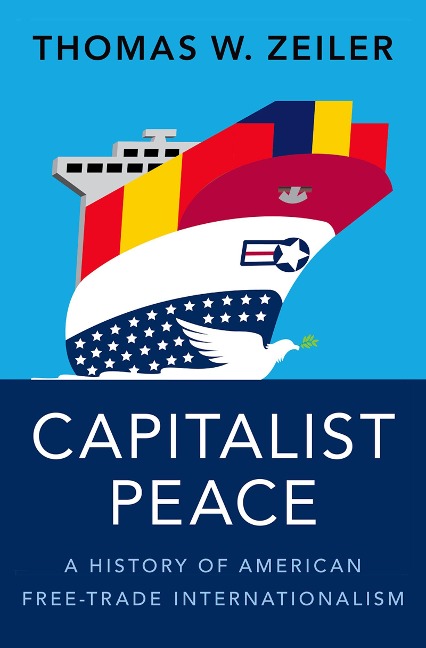
A wide-ranging history of modern America that argues that free trade has been an engine of US foreign policy and the key to global prosperity. Surprisingly, exports and imports, tariffs and quotas, and trade deficits and surpluses are central to American foreign relations. Ever since Franklin D. Roosevelt took office during the Great Depression, the United States has linked trade to its long-term diplomatic objectives and national security. Washington, DC saw free trade as underscoring its international leadership and as instrumental to global prosperity, to winning wars and peace, and to shaping the liberal internationalist world order. Free trade, in short, was a cornerstone of an ideology of "capitalist peace." Covering nearly a century, Capitalist Peace provides the first chronologically sweeping look at the intersection of trade and diplomacy. This policy has been pursued oftentimes at a cost to US producers and workers, whose interests were sacrificed to serve the purpose of grand strategy. To be sure, capitalists sought a particular type of global trade, which harnessed the market through free trade. This liberal trade policy sought the common good as defined by the needs, aims, and strengths of the capitalist and democratic world. Leaders believed that free trade advanced private enterprise, which, in turn, promoted prosperity, democracy, security, and attendant by-products like development, cooperation, integration, and human rights. The capitalist peace took liberalization as integral to cooperation among nations and even to morality in global affairs. Drawing on new research from the Reagan, George H.W. Bush, Clinton, and George W. Bush presidential libraries, as well as business/ industry and civic association archives, Thomas W. Zeiler narrates this history from the road to World War II, through the Cold War, to the resurgent protectionism of the Trump era and up to the present. Offering a new interpretation of diplomatic history, Capitalist Peace shows how US power, interests, and values were projected into the international arena even as capitalism brought both positive and negative results to the global order.
Thomas W. Zeiler is a Professor of History and Director of the Program in International Affairs at the University of Colorado Boulder. He is the author and editor of numerous books, including Free Trade, Free World: America and the Advent of GATT, Globalization and the American Century, and Annihilation: A Global Military History of World War II (OUP, 2010). He served as the President of the Society for Historians of American Foreign Relations and as editor of its journal, Diplomatic History.
Acknowledgments Abbreviations Introduction Capitalist Peace Chapter 1 Depression, 1930-1935 Chapter 2 Dictators, 1936-1940 Chapter 3 Universalism, 1941-1945 Chapter 4 Security, 1946-1950 Chapter 5 Containment, 1951-1954 Chapter 6 Offensive, 1955-1958 Chapter 7 Competition, 1959-1963 Chapter 8 Revolt, 1964-1970 Chapter 9 Shock, 1971-1979 Chapter 10 Victory, 1980-1990 Chapter 11 Globalization, 1991-2000 Chapter 12 Crisis, 2001-2021 Conclusion A Near-Century of Capitalist Peace Notes Bibliography Index
Dieses eBook wird im PDF-Format geliefert und ist mit einem Adobe Kopierschutz (DRM) versehen. Sie können dieses eBook mit allen Geräten lesen, die das PDF-Format und den Adobe Kopierschutz (DRM) unterstützen.
Zum Beispiel mit den folgenden Geräten:
• tolino Reader
Laden Sie das eBook direkt über den Reader-Shop auf dem tolino herunter oder übertragen Sie das eBook auf Ihren tolino mit einer kostenlosen Software wie beispielsweise Adobe Digital Editions.
• Sony Reader & andere eBook Reader
Laden Sie das eBook direkt über den Reader-Shop herunter oder übertragen Sie das eBook mit der kostenlosen Software Sony READER FOR PC/Mac oder Adobe Digital Editions auf ein Standard-Lesegeräte mit epub- und Adobe DRM-Unterstützung.
• Tablets & Smartphones
Möchten Sie dieses eBook auf Ihrem Smartphone oder Tablet lesen, finden Sie hier unsere kostenlose Lese-App für iPhone/iPad und Android Smartphone/Tablets.
• PC & Mac
Lesen Sie das eBook direkt nach dem Herunterladen mit einer kostenlosen Lesesoftware, beispielsweise Adobe Digital Editions, Sony READER FOR PC/Mac oder direkt über Ihre eBook-Bibliothek in Ihrem Konto unter „Meine eBooks“ - „online lesen“.
Schalten Sie das eBook mit Ihrer persönlichen Adobe ID auf bis zu sechs Geräten gleichzeitig frei.
Bitte beachten Sie, dass die Kindle-Geräte das Format nicht unterstützen und dieses eBook somit nicht auf Kindle-Geräten lesbar ist.