Stöbern
genialokal zum Startbildschirm hinzufügen
Installieren Sie die genialokal App auf Ihrem Startbildschirm für einen schnellen Zugriff und eine komfortable Nutzung.
Installieren Sie die genialokal App auf Ihrem Startbildschirm für einen schnellen Zugriff und eine komfortable Nutzung.
Tippen Sie einfach auf Teilen:
 Und dann auf "Zum Home-Bildschirm [+]".
Ihr gewünschter Artikel ist in 0 Buchhandlungen vorrätig - wählen Sie hier eine Buchhandlung in Ihrer Nähe aus:
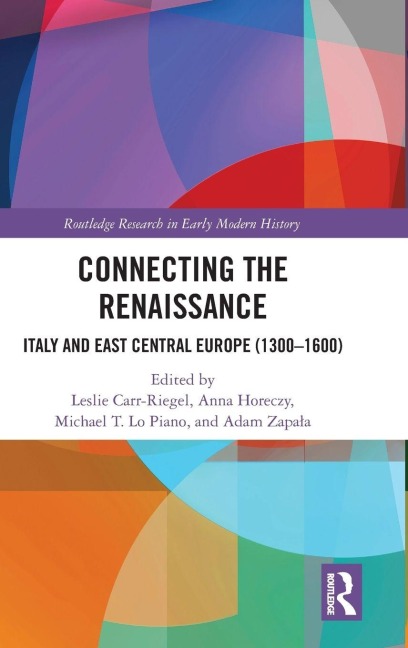
Why did Italian culture come to occupy such privileged status and interest among the societies of East-Central Europe during the period 1300-1600? In 1300, East-Central Europe regarded Italy not necessarily as an undisputed center of cultural emulation but drew from a much wider range of models centered in France, Germany, and even Kievan Rus'. Two centuries later the same region was saturated with Italianate forms - architecture, humanism, diplomacy, commerce, and print - that rivaled the most sophisticated centers of the High Renaissance. This volume argues that the transformation was neither passive reception nor mere "Italianism." Rather, East-Central-European societies deliberately appropriated, hybridized, and reinterpreted Italian practices and values specifically to achieve their own political, economic, and intellectual aims and meet an array of regional challenges. Ranging in focus from the fourteenth-century Italian mining practices to digital Latin corpus analysis, diplomatic history, and early print studies, together the chapters in this volume present nine case studies that draw on a number of methodologies, new sources, and fresh archival research that all advance an understanding of this important and complex phenomenon. This book is a vital reading for scholars of cultural transfer, early modern studies, and East-Central European history more broadly.
Leslie Carr-Riegel studied at Kalamazoo College, USA, before transferring to complete her BA at the American University in Rome. She took her first MA from the University of Durham before completing her second MA and PhD at the Central European University. She has worked as a teaching fellow at the Princeton University Global History Lab and was a fellow at the Käte Hamburger Kolleg "Legal Unity and Pluralism." Anna Horeczy is an assistant professor in the Department of Early Modern Studies at the Tadeusz Manteuffel Institute of History of the Polish Academy of Sciences in Warsaw, Poland. Her research interests focus on the reception of Italian intellectual culture in late medieval and early modern Poland and book and manuscript studies. Michael T. LoPiano received his PhD in history and Renaissance studies from Yale University in 2022 and his BA in history and Italian from Johns Hopkins University in 2015. He is a postdoctoral researcher in the Department of History and Archaeology at the University of Cyprus, where his research focuses on the reception of the Tablet of Cebes (-----) in Latin Europe during the period 1500-1850. Adam Zapäa is the head of the Digital History Lab in the Department of Historical Atlas of the Tadeusz Manteuffel Institute of History, Polish Academy of Sciences in Poland. His research interests focus on contacts between Poles and the Holy See in the second half of the fifteenth century, as well as on the impact of digital tools on historical research.
List of Contributors Introduction Michael LoPiano Chapter 1 Little Genoa - The First Italian Community in Poland Leslie Carr-Riegel Chapter 2 From Padua to Kraków: Niccolò Bonavia's De laudibus sancti Hieronymi and Its Manuscript Afterlife Anja Boži- Chapter 3 A Polish Bishop on the Italian Chessboard: Renaissance Diplomatic Patterns in Zbigniew Ole-nicki's Struggle for Cardinalate Confirmation Adam Zapäa Chapter 4 John of Capestrano and his Spiritual Networks: the Case of Bohemia Antonín Kalous and Petra Mutlová Chapter 5 The Humanist Library of Jan D-ugosz (1415-1480). An Attempt at Reconstruction Zdzis-aw Koczarski Chapter 6 Connecting the Italian Humanist Literary Circle to Poland: The Case of Callimachus, Conrad Celtis, and the Origins of the Sodalitas Litteraria Vistulana Michael LoPiano Chapter 7 Aldine Prints in Kraków at the Turn of the Sixteenth Century as Vehicles of Cultural Transfer Anna Horeczy Chapter 8 From Queen to Deceived Bride - Beatrice of Aragon's Struggle to Become the Wife of Vladislaus II Jagiellon Hajnalka Kuffart Chapter 9 Ippolito I d'Este's Episcopal Court in Eger (1498-1520) Ilona Kristóf Index