Stöbern
genialokal zum Startbildschirm hinzufügen
Installieren Sie die genialokal App auf Ihrem Startbildschirm für einen schnellen Zugriff und eine komfortable Nutzung.
Installieren Sie die genialokal App auf Ihrem Startbildschirm für einen schnellen Zugriff und eine komfortable Nutzung.
Tippen Sie einfach auf Teilen:
 Und dann auf "Zum Home-Bildschirm [+]".
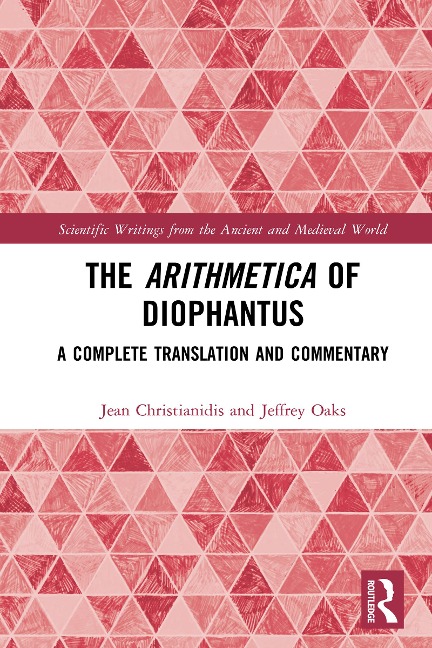
This volume offers an English translation of all ten extant books of Diophantus of Alexandria's Arithmetica, along with a comprehensive conceptual, historical, and mathematical commentary. Before his work became the inspiration for the emerging field of number theory in the seventeenth century, Diophantus (ca. 3rd c. CE) was known primarily as an algebraist. This volume explains how his method of solving arithmetical problems agrees both conceptually and procedurally with the premodern algebra later practiced in Arabic, Latin, and European vernaculars, and how this algebra differs radically from the modern algebra initiated by François Viète and René Descartes. It also discusses other surviving traces of ancient Greek algebra and follows the influence of the Arithmetica in medieval Islam, Byzantium, and the European Renaissance down to the 1621 publication of Claude-Gaspard Bachet's edition. After the English translation the book provides a problem-by-problem commentary explaining the solutions in a manner compatible with Diophantus's mode of thought. The Arithmetica of Diophantus provides an invaluable resource for historians of mathematics, science, and technology, as well as those studying ancient Greek, medieval Islamic and Byzantine, and Renaissance history. In addition, the volume is also suitable for mathematicians and mathematics educators.
Jean Christianidis is a professor of history of mathematics at the National and Kapodistrian University of Athens (Greece) and partner member of the Centre Alexandre-Koyré (Paris, France). He has authored or co-authored numerous articles on Diophantus and on Greek and Byzantine mathematics. Jeffrey Oaks is a mathematics professor at University of Indianapolis (USA). He is co-author of the 2021 book Al-Hawari's Essential Commentary: Arabic Arithmetic in the Fourteenth Century.
Part I: Introduction, 1. Diophantus and his work, 2. Numbers, problem solving, and algebra, 3. History, 4. Structure and language of the Arithmetica, 5. The didactic aspect of the Arithmetica, Part II: Translation, Part III: Commentary, Part IV: Appendices.
Dieses eBook wird im PDF-Format geliefert und ist mit einem Adobe Kopierschutz (DRM) versehen. Sie können dieses eBook mit allen Geräten lesen, die das PDF-Format und den Adobe Kopierschutz (DRM) unterstützen.
Zum Beispiel mit den folgenden Geräten:
• tolino Reader
Laden Sie das eBook direkt über den Reader-Shop auf dem tolino herunter oder übertragen Sie das eBook auf Ihren tolino mit einer kostenlosen Software wie beispielsweise Adobe Digital Editions.
• Sony Reader & andere eBook Reader
Laden Sie das eBook direkt über den Reader-Shop herunter oder übertragen Sie das eBook mit der kostenlosen Software Sony READER FOR PC/Mac oder Adobe Digital Editions auf ein Standard-Lesegeräte mit epub- und Adobe DRM-Unterstützung.
• Tablets & Smartphones
Möchten Sie dieses eBook auf Ihrem Smartphone oder Tablet lesen, finden Sie hier unsere kostenlose Lese-App für iPhone/iPad und Android Smartphone/Tablets.
• PC & Mac
Lesen Sie das eBook direkt nach dem Herunterladen mit einer kostenlosen Lesesoftware, beispielsweise Adobe Digital Editions, Sony READER FOR PC/Mac oder direkt über Ihre eBook-Bibliothek in Ihrem Konto unter „Meine eBooks“ - „online lesen“.
Schalten Sie das eBook mit Ihrer persönlichen Adobe ID auf bis zu sechs Geräten gleichzeitig frei.
Bitte beachten Sie, dass die Kindle-Geräte das Format nicht unterstützen und dieses eBook somit nicht auf Kindle-Geräten lesbar ist.