Stöbern
genialokal zum Startbildschirm hinzufügen
Installieren Sie die genialokal App auf Ihrem Startbildschirm für einen schnellen Zugriff und eine komfortable Nutzung.
Installieren Sie die genialokal App auf Ihrem Startbildschirm für einen schnellen Zugriff und eine komfortable Nutzung.
Tippen Sie einfach auf Teilen:
 Und dann auf "Zum Home-Bildschirm [+]".


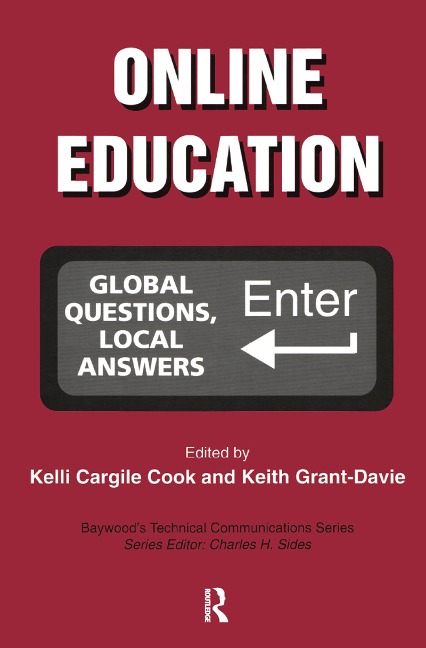
In "Online Education: Global Questions, Local Answers", 24 college educators focus on the most important questions to be addressed by all scholar-teachers and administrators committed to developing high-quality online education programs. We describe these questions as "global" because they transcend the particular situations of individual institutions. They are questions that everyone involved in online education needs to address: What are the issues to consider when first developing and then sustaining an online education program? How do we create interactive, pedagogically sound online courses and classroom communities? How should we monitor and assess the quality of online courses and programs? And how should recent developments and innovations in online education cause us to reexamine our roles and responsibilities as educators in technical communication?While these global questions affect all of us in one way or another, they demand different local answers, such as those presented by the contributors to this text. Readers will need to consider which of these local answers might apply to their own situations and how these answers might need to be adapted to reflect the particular needs of their own institutions.
Kelli Cargile Cook an d Keith Grant-Davie,
Introduction SECTION 1: HOW DO WE CREATE AND SUSTAIN ONLINE PROGRAMS AND COURSES? CHAPTER 1 Applying Technical Communication Theory to the Design of Online Education Marjorie T. Davis CHAPTER 2 Students in the Online Technical Communication Classroom Angela Eaton CHAPTER 3 An Argument for Pedagogy-Driven Online Education Kelli Cargile Cook CHAPTER 4 Strategic Planning for Online Education: Sustaining Students, Faculty, and Programs Carolyn Rude SECTION 2: HOW DO WE CREATE INTERACTIVE, PEDAGOGICALLY SOUND ONLINE COURSES AND CLASSROOM COMMUNITIES? CHAPTER 5 Changing Roles for Online Teachers of Technical Communication Nancy W. Coppola CHAPTER 6 Teaching Well Online with Instructional and Procedural Scaffolding Helen M. Grady and Marjorie T. Davis CHAPTER 7 Mind the Gap(s): Modeling Space in Online Education Locke Carter and Rebecca Rickly CHAPTER 8 Enhancing Online Collaboration: Virtual Peer Review in the Writing Classroom Lee-Ann Kastman Breuch CHAPTER 9 Replicating and Extending Dialogic Aspects of the Graduate Seminar in Distance Education Susan Lang CHAPTER 10 Paralogy and Online Pedagogy Mark Zachry SECTION 3: HOW SHOULD WE MONITOR AND ASSESS THE QUALITY OF ONLINE COURSES AND PROGRAMS? CHAPTER 11 Students' Technological Difficulties in Using Web-Based Learning Environments Philip Rubens and Sherry Southard CHAPTER 12 Activity Theory and the Online Technical Communication Course: Assessing Quality in Undergraduate Online Instruction Kristin Walker CHAPTER 13 An Assignment Too Far: Reflecting Critically on Internships in an Online Master's Program Keith Grant-Davie CHAPTER 14 Online Course and Instructor Evaluations Kelli Cargile Cook and Keith Grant-Davie CHAPTER 15 Assessing Student Interaction in the Global Classroom Project: Visualizing Communication and Collaboration Patterns Using Online Transcripts Cassie Avery, Jason Civjan, and Aditya Johri SECTION 4: HOW IS ONLINE EDUCATION CHALLENGING OUR ASSUMPTIONS? CHAPTER 16 The Global Classroom Project: Troublemaking and Troubleshooting TyAnna Herrington and Yuri Tretyakov CHAPTER 17 Knowledge Politics: Open Sourcing Education Brenton Faber and Johndan Johnson-Eilola CHAPTER 18 Extreme Pedagogies: When Technical Communication Vaults Institutional Barriers Billie J. Wahlstrom and Linda S. Clemens Contributors Index
Dieses eBook wird im PDF-Format geliefert und ist mit einem Adobe Kopierschutz (DRM) versehen. Sie können dieses eBook mit allen Geräten lesen, die das PDF-Format und den Adobe Kopierschutz (DRM) unterstützen.
Zum Beispiel mit den folgenden Geräten:
• tolino Reader
Laden Sie das eBook direkt über den Reader-Shop auf dem tolino herunter oder übertragen Sie das eBook auf Ihren tolino mit einer kostenlosen Software wie beispielsweise Adobe Digital Editions.
• Sony Reader & andere eBook Reader
Laden Sie das eBook direkt über den Reader-Shop herunter oder übertragen Sie das eBook mit der kostenlosen Software Sony READER FOR PC/Mac oder Adobe Digital Editions auf ein Standard-Lesegeräte mit epub- und Adobe DRM-Unterstützung.
• Tablets & Smartphones
Möchten Sie dieses eBook auf Ihrem Smartphone oder Tablet lesen, finden Sie hier unsere kostenlose Lese-App für iPhone/iPad und Android Smartphone/Tablets.
• PC & Mac
Lesen Sie das eBook direkt nach dem Herunterladen mit einer kostenlosen Lesesoftware, beispielsweise Adobe Digital Editions, Sony READER FOR PC/Mac oder direkt über Ihre eBook-Bibliothek in Ihrem Konto unter „Meine eBooks“ - „online lesen“.
Schalten Sie das eBook mit Ihrer persönlichen Adobe ID auf bis zu sechs Geräten gleichzeitig frei.
Bitte beachten Sie, dass die Kindle-Geräte das Format nicht unterstützen und dieses eBook somit nicht auf Kindle-Geräten lesbar ist.