Stöbern
genialokal zum Startbildschirm hinzufügen
Installieren Sie die genialokal App auf Ihrem Startbildschirm für einen schnellen Zugriff und eine komfortable Nutzung.
Installieren Sie die genialokal App auf Ihrem Startbildschirm für einen schnellen Zugriff und eine komfortable Nutzung.
Tippen Sie einfach auf Teilen:
 Und dann auf "Zum Home-Bildschirm [+]".
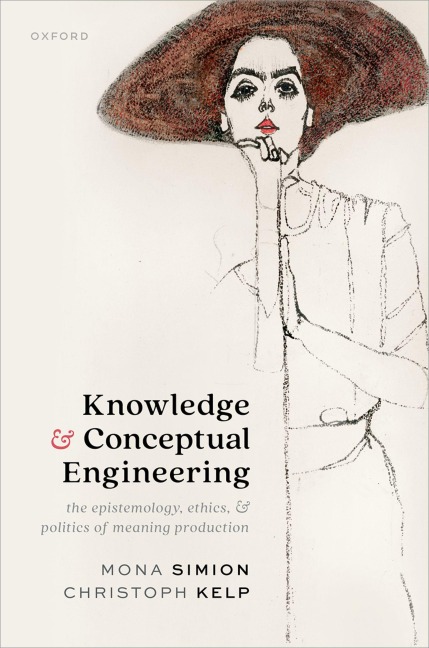
Suppose you could change people's way of thinking about the world at its very roots, by changing the very concepts by means of which they think. Suppose, further, that this would make the world a better place; that would be quite something. Knowledge and Conceptual Engineering is a comprehensive and systematic study of the nature and normativity of conceptual engineering. This book comprehensively deals with all the central questions in the field: the very possibility of conceptual engineering, its success conditions, the epistemic and moral permissibility of conceptual engineering, the nature of conceptual ignorance and conceptual understanding, and duties to engage in conceptual engineering. It also considers the political aspects, such as engineering social kind concepts, the nature of hermeneutical injustice, and conceptual disinformation. Mona Simion and Christoph Kelp develop a systemic and unified framework centred on conceptual functions, and espouse a functionalist approach that is wholeheartedly optimistic, in that it takes conceptual engineering to be something that we can and should do.
Mona Simion is Professor of Philosophy and Michael Cohen Fellow of the Exeter College at the University of Oxford. Her research focuses on epistemology, philosophy of language, and moral and political philosophy. She is the author of Knowledge-First Epistemology: A Defence (CUP 2025), Resistance to Evidence (CUP, 2024), Shifty Speech and Independent Thought (OUP, 2021), and Sharing Knowledge (CUP, 2021, with Christoph Kelp), and co-editor of Reasons, Justification, and Defeat (OUP, 2021, with Jessica Brown). She is the Mind Fellow 2018 and the winner of the Young Epistemologist Prize 2021. She has led major research projects funded by the European Research Council and the Leverhulme Trust. Christoph Kelp is Professor of Philosophy and Co-Director of the Cogito Epistemology Research Centre at the University of Glasgow. His work is in epistemology, philosophy of language, philosophy of science, and ethics. He is the author of The Nature and Normativity of Defeat (CUP 2023), Inquiry, Knowledge, and Understanding (OUP 2021), Sharing Knowledge (CUP 2021, with Mona Simion), and Good Thinking (Routledge 2018), and co-editor of Virtue Theoretic Epistemology (CUP 2020 with John Greco). He is the winner of the Young Epistemologist Prize 2017. He has led major research projects funded by the Leverhulme Trust, the Swiss National Science Foundation, and Research Foundation Flanders.
- Part I. Conceptual Engineering: Foundational Issues - Chapter 1: Conceptual Engineering: Repair, Replacement, and Innovation - Chapter 2: The Case Against Conceptual Engineering - Chapter 3: Conceptual Innovation - Part II. Conceptual Ethics and Conceptual Epistemology - Chapter 4: Normative Restrictions on Conceptual Engineering - Chapter 5: Conceptual Ignorance - Chapter 6: Expressive Power and Duties of Meaning Production - Part III. Conceptual Politics - Chapter 7: Engineering Social Kind Concepts - Chapter 8: Expressive Power, Hermeneutical Injustice, and Conceptual Access - Chapter 9: On Conceptual Disinformation - Conclusion
Dieses eBook wird im PDF-Format geliefert und ist mit einem Adobe Kopierschutz (DRM) versehen. Sie können dieses eBook mit allen Geräten lesen, die das PDF-Format und den Adobe Kopierschutz (DRM) unterstützen.
Zum Beispiel mit den folgenden Geräten:
• tolino Reader
Laden Sie das eBook direkt über den Reader-Shop auf dem tolino herunter oder übertragen Sie das eBook auf Ihren tolino mit einer kostenlosen Software wie beispielsweise Adobe Digital Editions.
• Sony Reader & andere eBook Reader
Laden Sie das eBook direkt über den Reader-Shop herunter oder übertragen Sie das eBook mit der kostenlosen Software Sony READER FOR PC/Mac oder Adobe Digital Editions auf ein Standard-Lesegeräte mit epub- und Adobe DRM-Unterstützung.
• Tablets & Smartphones
Möchten Sie dieses eBook auf Ihrem Smartphone oder Tablet lesen, finden Sie hier unsere kostenlose Lese-App für iPhone/iPad und Android Smartphone/Tablets.
• PC & Mac
Lesen Sie das eBook direkt nach dem Herunterladen mit einer kostenlosen Lesesoftware, beispielsweise Adobe Digital Editions, Sony READER FOR PC/Mac oder direkt über Ihre eBook-Bibliothek in Ihrem Konto unter „Meine eBooks“ - „online lesen“.
Schalten Sie das eBook mit Ihrer persönlichen Adobe ID auf bis zu sechs Geräten gleichzeitig frei.
Bitte beachten Sie, dass die Kindle-Geräte das Format nicht unterstützen und dieses eBook somit nicht auf Kindle-Geräten lesbar ist.